Nazi Germany
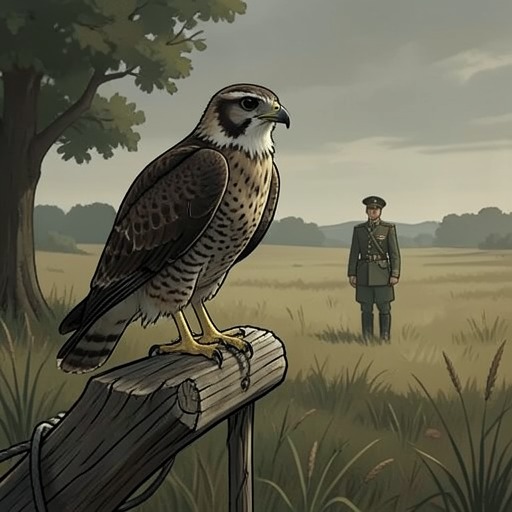
H is for HawkNazi Germany enters Helen Macdonald’s narrative as a historical setting in which falconry became more than a sporting tradition: its images and institutions could be enlisted to naturalize hierarchy, power, and violence. The 1937 Berlin International Hunting Exhibition makes that political association concrete, while Macdonald’s reading of T. H. White’s training of Gos gives it a more intimate, psychologically charged dimension. Together, these strands show how the hawk can be treated as an animal with its own behavior and needs, or turned into an emblem for human systems of domination.
Falconry and political symbolism
Falconry had long carried class distinctions that Macdonald sets beside its later political uses. In the account she gives of Gilbert Blaine’s writing, the peregrine was elevated as a noble and perfect bird, but flying falcons properly required access to open country, including grouse moors and large estates. Blaine explicitly associated possession of these birds with aristocratic privilege. By contrast, the solitary trainer of goshawks or sparrowhawks, the austringer, was disparaged in older writing, and goshawks themselves were repeatedly described as unruly, difficult, or inferior to peregrines. These reputations disclose a social hierarchy within falconry: the birds’ supposed qualities were bound up with who could fly them and where.
That inheritance provides context for the exhibition in Germany, where falconry’s symbolism flourished despite the small number of practitioners. The image on the exhibition catalogue showed a stylized naked Übermensch holding a golden hawk. Macdonald connects this image to a political ideal that made power and domination appear natural: the hawk could be presented as an elite creature, taking weaker prey without guilt. The point is not that the bird itself belongs to an ideology, but that people can use its strength and predatory life to lend an apparently natural authority to political hierarchy.
The Berlin exhibition
In 1937, Gilbert Blaine and Jack Mavrogordato travelled to Berlin with a British falconry display of mounted birds, equipment, photographs, books, and paintings. Macdonald suspects their presence may also have served as diplomatic cover: Lord Halifax, Britain’s pro-appeasement Foreign Secretary, was travelling to Germany for secret talks with Hitler. The book presents this as a suspicion rather than a confirmed explanation for the falconers’ last-minute participation.
The exhibition’s setting made its political atmosphere unmistakable. Germany’s national falconry association, the Deutscher Falkenorden, had state patronage, and the Reichsfalkenhof, a large half-timbered State Falconry Centre, had recently been built in the forest at Riddagshausen. Blaine and Mavrogordato walked through halls filled with antlers and red banners bearing swastikas. They admired the hawks, falcons, and eagles displayed there, but found the open-air demonstrations less impressive: a saker falcon took a tethered pigeon, while an eagle was released at a rabbit so tame it continued nibbling grass until the eagle landed.
Only Germany and Britain had falconry displays at the exhibition. Germany won first prize; the British Falconers’ Club came second. The bronze falcon awarded to the British club was later found by Macdonald in a cupboard belonging to Gordon. Hermann Göring had sent it to the club after the exhibition. The object’s craftsmanship and value did not make it welcome: Macdonald describes it as something both she and another person wished had never been made. Its history connects an apparently decorative prize to Göring, Hitler’s right-hand man and commander-in-chief of the Luftwaffe, and to the political world that had elevated falconry as a national symbol.
White, Gos, and the imagined war
The political symbolism of the hawk also changes the way Macdonald reads White’s account of Gos. She describes Gos as becoming, in White’s imagination, the violent and irrational force of fascism made flesh. White called the bird a Hittite and associated him with the sacrificial violence of Moloch; in Macdonald’s interpretation, the hawk carried the glamour and terror of dictatorship. This is a reading of White’s representation, not a claim that Gos was literally a political creature.
Macdonald places that interpretation beside White’s unsettled politics. He loathed capitalism, had once been attracted to Communism’s revolutionary energy, and feared that revolution would erase the individuality he believed was all he possessed. He wondered whether he might be a fascist, disliked Hitler, and also distrusted the British government. He opposed nationalism but did not believe people were equal. His political uncertainty accompanied an apocalyptic hope that war might destroy civilization yet leave survivors wiser. Against that background, Macdonald reads the training of Gos as a private contest over violence and control: White chose to shoot rabbits rather than people and, through the hawk, fought what he understood as the dictator within himself.
The conflict takes place not on a battlefield but across White’s kitchen, barn, garden, and wood. When White recognizes himself in the dictator, Macdonald says, he tastes defeat, engineers the hawk’s loss, and pushes it away. The narrative then moves to his retreat into forest shelters, where he hopes to bring down hawks that resemble the aircraft of his nightmares. His history of fear gives this imagery another dimension: as a boy he dreamed of planes pursuing him, and later explained that he had learned to fly because he was afraid of aeroplanes. Macdonald suggests that taking the airman’s perspective may have been an attempt to master fear, just as the struggle with Gos enacted a battle with violence and authority.
Class, conduct, and the limits of the emblem
Macdonald’s account does not leave the hawk fixed as a symbol of fascist power. Elsewhere, her reading of falconry’s history sets the contemptuous descriptions of goshawks in later books against seventeenth-century accounts of them as shy, familiar, and responsive to kind treatment. In those earlier accounts, a hawk’s fear or resistance could be understood as a response to harsh handling rather than proof of a defective or irrational nature. This contrast matters to the political strand: the same animal can be made to signify domination, or approached as a self-willed being whose behavior depends partly on how people treat it.
A comparison with hunting in Maine extends the book’s attention to access and privilege without equating different places or periods. Macdonald describes a common-law tradition in which land could be hunted over, and contrasts it with Britain’s restricted estates and elite hunting grounds. The comparison recalls the class structure behind falconry’s prestige and shows that access to land shapes who can participate in hunting. It also sets the Berlin exhibition’s official grandeur against other social arrangements in which hunting is more widely shared.
Within the narrative, Nazi Germany is therefore not a detached historical excursus. The Berlin prize links falconry to state spectacle; Göring’s interest in hawks reveals how predatory power could be recruited into political imagery; and White’s relationship with Gos turns that imagery inward, into a conflict over violence, fear, and control. Macdonald’s shifting emphasis—from the bronze trophy to the living hawk, from political emblem to animal behavior—keeps the symbolism in view without allowing it to erase the creature it claims to explain.